
Federal Custody Outside Amelia
No federal prison was identified inside Amelia County in the official research. The Federal Bureau of Prisons operates a nationwide institution and records system. A federal case connected with Amelia can therefore produce custody hundreds of miles from the county. The arrest site does not determine the prison, and a PRJ record does not establish that BOP ever assumed responsibility.
Custody stage controls the correct search. The U.S. Marshals Service manages many people awaiting federal trial, sentencing, or movement. Those prisoners can occupy state or local contract beds without appearing as sentenced BOP inmates. Once a person is committed to BOP, the BOP Inmate Locator becomes the main public starting point. The federal court docket remains essential because it identifies the case, judgment, sentence, and later court action.
Search Federal Bureau Release Records
The BOP locator covers federal inmates from 1982 to the present. Search by BOP register number when known because it is more precise than a name. The name route also permits identifying filters. Compare the full result carefully, record the date checked, and preserve the exact label shown by BOP.
- Open the official BOP Inmate Locator and choose the number or name search.
- Enter the register number, or use the complete name and available identifying filters.
- Open the matching result and copy the location or status wording exactly.
- Record any displayed release date and whether the result says “Released.”
- Compare the result with the federal criminal docket and any BOP record needed to confirm the event.
- If the person is in a pretrial stage, use the court and Marshals route instead of assuming a missing BOP record proves release.
The BOP locator may show a historical release date, which makes it more useful after federal custody than a current local roster. Still, BOP warns that a person can be outside its physical custody for court process or another authority. “Not in BOP custody” is not a complete destination. The result must be paired with the court record or the next custodian when the destination matters.
The official BOP locator shown here is the successful federal image captured for this project.
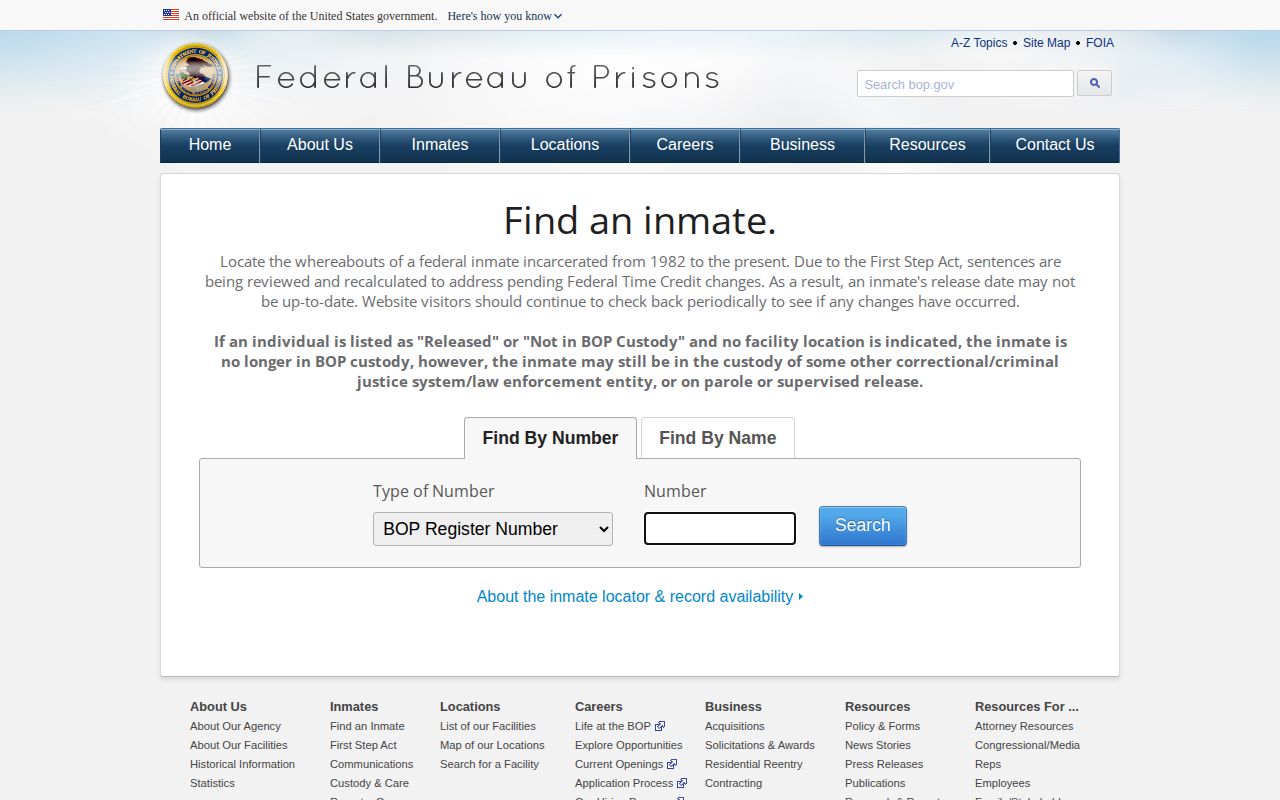
The screen establishes the official search entry point and released-date capability. It does not establish the next destination without a matching person result and federal case review.
Read Federal Release Results
Each federal source answers a limited question. Avoid blending the BOP result, court judgment, and transfer record into one unsupported conclusion. The strongest release finding identifies the person, source, date, and custody system that ended.
| Source or field | What it can establish |
|---|---|
| BOP register number | Connects the result to a unique federal inmate record. |
| BOP location or status | Shows the custody or release wording currently reported by BOP. |
| Displayed release date | Records the date BOP associates with release for that entry. |
| Federal docket | Shows charges, detention orders, judgment, sentence, appeals, and later court action. |
| Marshals custody information | Addresses pretrial movement or custody that may not appear as a BOP sentence. |
| PRJ transfer entry | Can name the authority that took a person from the regional jail. |
A release date in the locator supports departure from the BOP custody described by that record. It does not rule out a new case, state custody, immigration custody, or supervision in the community. Federal supervised release is a court-ordered period after imprisonment. It is not continued prison custody, and it is not the same as complete discharge from the federal sentence.
Note: Preserve the BOP register number and the federal case number so records from different custody stages are not joined by name alone.
Marshals Custody Before BOP
The U.S. Marshals prisoner information describes the federal agency's role in managing and transporting many pretrial prisoners. It does not provide a general public historical release roster comparable to the BOP locator. A defendant can remain under Marshals authority while housed in a local or state contract facility. Physical location and legal custodian may therefore differ.
For a pretrial federal person, the federal docket or counsel is often the stronger route. Read detention, bond, transfer, plea, judgment, and sentencing entries in sequence. A court release order can precede the physical handoff or exit. A transfer for court proceedings can also place the person outside BOP walls without ending federal custody.
Do not use BOP merely because the case is federal. Search BOP after commitment or when its locator contains the matching record. If no record appears, check the spelling and identifiers, then return to the docket and Marshals custody path. A negative name search is not proof that the person was released.
PRJ Transfers Into Federal Custody
PRJ states that it houses local, state, and U.S. Marshals offenders. This mixed-authority population makes disappearance from the PRJ current lookup unusually hard to interpret. An Amelia local record can stop appearing because another custodian took the person, not because the person returned to the community. That is the research-supported Angle T distinction for this federal path.
Ask PRJ for the departure date, release or transfer type, authority, receiving agency, and disposition of any hold. A transfer notation to the Marshals Service links the regional-jail event to the federal case. It does not prove that the person entered a BOP prison that day. Court proceedings and later designation can intervene.
The sequence should read: PRJ current check, PRJ transfer entry, federal docket, Marshals stage when applicable, then BOP locator after commitment. Record an “as of” time for each source. That chain keeps “released from PRJ,” “in federal custody,” and “released from BOP” as separate findings.
Confirm Federal Community Release
A BOP result marked “Released” is valuable but should be confirmed when the destination affects a legal or personal inquiry. Review the docket for the sentence, release conditions, modifications, or warrants. Seek BOP records when the locator does not supply enough detail. If immigration custody is plausible, use the official ICE channel separately rather than inferring the outcome from BOP.
Read the release date beside the identity and status in the same BOP result. Do not copy a date from a similar name. When the docket shows more than one federal case, determine which judgment produced the BOP record and whether another matter remained open. A later arrest or revocation can create a new custody period that the earlier release date does not describe.
The phrase community release means the available records support return to the community. Conditional release means the person left confinement subject to legal conditions. Transfer means one custodian handed the person to another. Discharge should be used only when the source says the relevant sentence, supervision, or custody ended. These labels prevent a BOP date from being stretched beyond what it proves.
- BOP release
- The federal prison record reports an end to the BOP custody shown for that entry.
- Federal supervised release
- The person is outside prison but remains subject to court-ordered federal supervision.
- Marshals transfer
- Custody or movement remains under federal authority during a pretrial or transport stage.
- Complete discharge
- The official record must support the end of the relevant custody and supervision.
For the broader Amelia custody trail, the Amelia County released-inmate search separates PRJ, VADOC, federal, and immigration sources. Use no more of that chain than the evidence requires.
Federal Bureau Records and Contact
The BOP system is nationwide, so the correct contact depends on the institution or record shown in the locator. Use the locator result and the official BOP locations directory to identify the responsible institution. For historical information, use BOP's official records process. For an active court case, contact the federal clerk or counsel through the relevant docket information.
A records inquiry should identify the full name, BOP register number, date of birth when appropriate, federal case number, and approximate custody dates. Ask for the existing release or custody-status record rather than a custom legal conclusion. If the inquiry began at PRJ, attach the regional jail's receiving-agency notation so BOP staff can see why the federal system is being checked.
Federal Bureau of Prisons Facilities and SystemNationwide federal corrections system
BOP Inmate Locator
BOP Locations Directory
No Amelia street address or local BOP release desk is supported by the research. Do not route a federal release inquiry to PRJ unless the first question concerns PRJ's own transfer entry. Agency roles remain distinct.
Keep the response with the locator capture and docket entry. A dated agency response can resolve a historical question after the public locator changes, while the court record supplies the legal context that a custody database may omit.