
VADOC Release Paths for Amelia
There is no VADOC prison identified inside Amelia County in the official directory. The state connection begins when a person becomes state responsible, even if the person remains for a time in a local or regional jail bed. VADOC may later place the person in a reception center, institution, hospital, CCAP setting, or another location. On release from prison, a district Probation and Parole Office can supervise the person in the community.
A PRJ transfer to VADOC is not a community release. It ends the regional jail's custody and starts or continues state responsibility. A later state prison release can lead to parole, probation, post-release supervision, or another conditional status. Full discharge is different again. The exact state and court records determine which event occurred.
| Displayed route | What it supports | Next check |
|---|---|---|
| Named VADOC institution | Current reported state confinement | Institution record and time computation |
| Regional jail under VADOC authority | State responsibility in a local bed | VADOC plus the physical custodian |
| District probation or parole office | Community supervision outside prison | Sentencing order and supervising office |
| No active locator result | No conclusion by itself | VADOC historical records and court |
Search VADOC Release Status
The official Inmate & Supervisee Locator covers incarcerated people and named supervisee populations. Search with a seven-digit DOC ID when known because it best separates similar names. A name search requires at least the first three letters of the first name and the full last name. Optional filters include location, race, gender, and age range.
- Open the locator, read the warning, and accept the required disclaimer.
- Enter the seven-digit DOC ID or the required name fields. Add only useful optional filters.
- Compare the full identifying details instead of choosing the first similar name.
- Read the exact location and status. Distinguish an institution from a district supervision office.
- Save the date checked. VADOC says its data is updated daily and can be inaccurate or outdated.
The captured locator page below comes from the official VADOC search source.
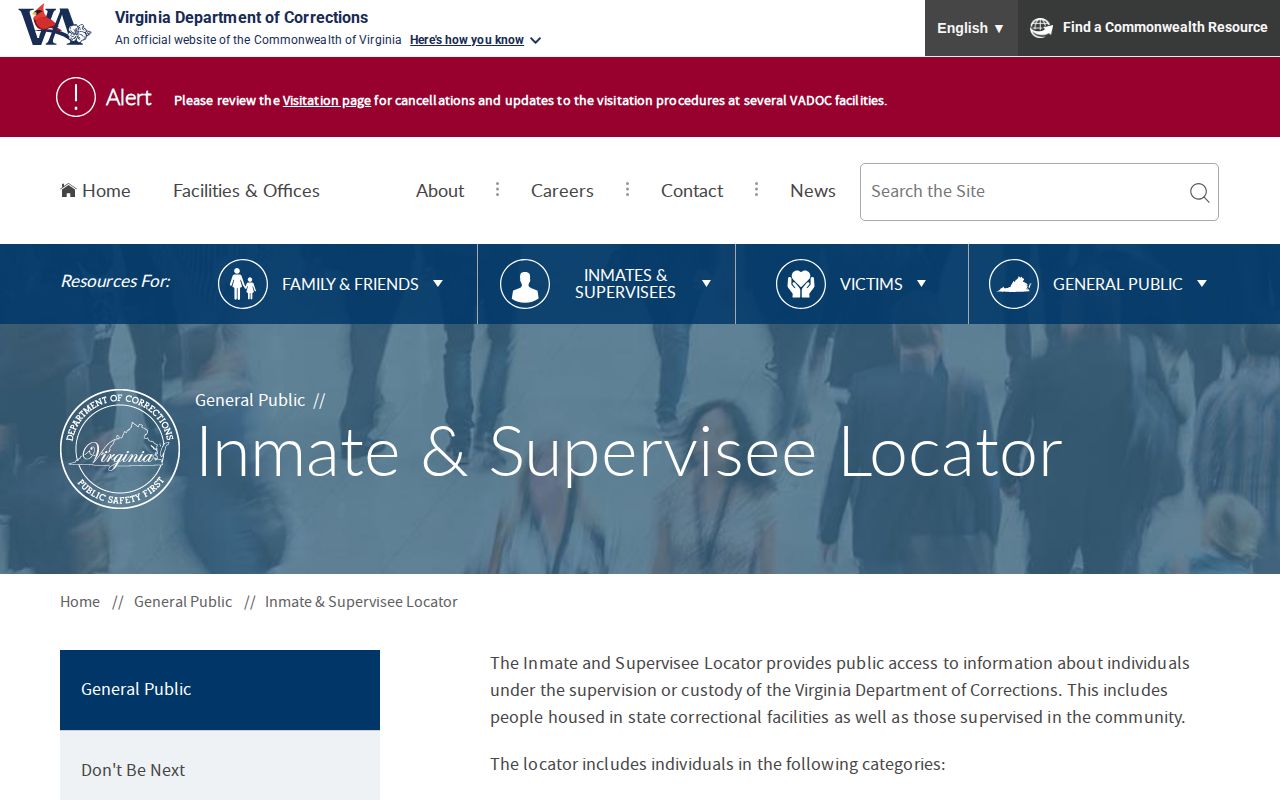
The image establishes the statewide search route, not any individual's release. A live detail record controls its own labels, location, and warning.
Interpret VADOC Release Results
A named prison, jail, or institutional location supports current custody within the scope of the state record. A probation or parole district office indicates the person is outside prison under active VADOC community supervision. It does not mean the sentence or supervision is discharged. The sentencing order remains the best source for the type and length of supervision.
The locator is built around active custody and supervision. It is not promised as a permanent discharge archive. A fully discharged former prisoner may not appear. A negative name result can also reflect spelling, identifiers, update timing, or a population outside the tool. Request historical release or discharge information from VADOC and compare it with the sentencing court.
Does a district office location mean parole? Not necessarily. VADOC Community Corrections supervises probationers, parolees, and people under other lawful community terms. Use the court order and official status to name the supervision correctly.
VADOC Release Date Records
The static locator page does not promise that every detail record shows a projected, tentative, anticipated, good-time, mandatory, or parole-eligibility date. Those terms are not synonyms. Copy the exact live field label and its disclaimer when a date appears. Never calculate a date and present it as a VADOC value.
VADOC calculates applicable state-responsible terms. Inputs can include the effective sentence, jail credit, concurrent or consecutive terms, credit system, conduct class, disciplinary action, later sentences, detainers, revocations, and court corrections. Each record is individual. Local authorities calculate many local sentences, so the state system should not be used to predict a short PRJ term that never became state responsible.
- Projected or anticipated date
- A planning value under the exact agency label, not a guaranteed exit appointment.
- Parole eligibility
- The point at which a qualifying sentence may be considered, not a grant or release.
- Actual release
- The event when VADOC custody changes as recorded by the department.
- Discharge
- The end of the relevant sentence or supervision when the official record says it ended.
VADOC Release Credit Systems
Virginia uses more than one time-credit system. Good Conduct Allowance generally concerns older eligible sentences, while Earned Sentence Credit generally concerns felony offenses committed on or after January 1, 1995. The VADOC Time Computation page describes ESC-1 and ESC-2 categories, but the applicable rate depends on offense, date, legal eligibility, class level, conduct, and program requirements.
The common 85 percent shorthand is not a universal Virginia rule. The maximum 4.5 days of credit per 30 days served for listed ESC-1 offenses produces a different mathematical share, and other eligible offenses may fall under a higher possible credit rate. GCA has its own classes and rates. No single percentage should be applied to every Amelia sentence.
Traditional discretionary parole was abolished for most post-1994 felony offenses, subject to statutory exceptions. Older parole-eligible sentences, juvenile-offender provisions, and geriatric conditional release require their own analysis. Eligibility allows consideration and does not prove that the Virginia Parole Board granted release or that VADOC completed it.
VADOC Post-Release Supervision Offices
The Virginia Parole Board makes discretionary parole and certain conditional-release decisions. VADOC Community Corrections carries out field supervision through district offices. The Board is not the day-to-day reporting office. A locator result naming a district should be checked against the VADOC facilities and offices directory rather than assigning an office solely from county geography.
Specialized caseloads and transfers can change the office. Public confirmation should stay with the status and office shown by an official source. Do not publish private schedules, case-plan details, or reporting information. A person whose active supervision ended may disappear from the locator, which calls for VADOC records or the sentencing court when historical discharge is the question.
Note: A parole decision date, proposed effective date, and actual VADOC release date can differ because conditions, detainers, or processing intervene.
Request VADOC Release Records
When the active locator does not answer a historical question, request the narrow release or discharge fields maintained by VADOC. Useful targets include release or discharge date, custody-status history, public sentence or time-computation summary, and a releasable public offender photograph if maintained. Inmate files contain security, privacy, and statutory restrictions, so a focused request is stronger than a demand for the full file.
P.O. Box 26963
Richmond, VA 23261
Phone: (804) 674-3000
Official contact
VADOC FOIA
Provide the seven-digit DOC ID where possible, full name, relevant date range, and Amelia sentencing court or case number. Ask for electronic delivery and a cost estimate. Fees depend on lawful actual response costs, not a universal state offender-search fee.
VADOC Release Notifications and NAAVI
VADOC's current victim-notification system is NAAVI, or Notification and Assistance for Victim Inclusion. VADOC states that NAAVI is separate from local-jail VINE. A person held at PRJ on a local sentence follows the Jail VINE route, while an eligible crime victim seeking state-custody notifications uses VADOC Victim Services and its registration process.
NAAVI can include anticipated and actual release events and other listed state-custody changes, but eligibility differs from public Jail VINE registration. Do not present it as an open public alert tool for every searcher. A notification should be saved with its event, agency, and time, then compared with VADOC records when the exact status matters.
The Amelia County released inmates home page explains the earlier PRJ, court, and transfer chain. Use that regional record first when a person began in Amelia local custody, then use VADOC after the evidence points to state responsibility.
PRJ and VADOC Releases Differ
PRJ records the physical adult regional-jail event. VADOC records state responsibility, institutional placement, state time computation, prison release, and active community supervision within its systems. When an Amelia defendant moves from PRJ to VADOC, preserve both records. The first identifies when regional custody ended and who received the person. The second identifies state intake and later status.
A court order connects those stages but does not replace either agency's operational record. The sentencing court supplies the imposed term, suspended part, credit directions, probation, and later revocation orders. VADOC applies the state-responsible calculation under current law and the individual record. This three-source comparison prevents a PRJ transfer date from being published as a prison release date, or a VADOC district-office result from being described as full discharge.