
Amelia Projected Versus Actual Release
A projected, anticipated, or tentative date is calculated from the sentence and the facts in the custodian's file. It may help with planning, but it is not the same as the physical release date. “Good time release,” “mandatory release,” “parole eligibility,” and “actual release” also have distinct meanings. Parole eligibility is only the point at which an eligible person can be considered by the Virginia Parole Board. An order, detainer, credit change, or later sentence can keep the person in custody beyond an earlier estimate.
For an Amelia local case, Piedmont Regional Jail records the time the person actually leaves its custody or transfers to another authority. The Amelia court record explains the sentence, bond, dismissal, or order. For a state-responsible sentence, VADOC computes the applicable date. A named prison or jail in a current result means custody continues. A supervision-office location may show release from prison with legal supervision still active.
Pretrial custody works differently. A person awaiting trial has no sentence to reduce with earned credits. Bond terms, dismissal, a plea or trial, and unresolved holds determine whether and when PRJ can release the person. Even a judge's order may precede physical exit while staff verify other process.
Find an Amelia Projected Release Date
Begin with the custody class, not a date calculator. PRJ handles the principal adult local-custody route for Amelia County even though the regional jail is in Farmville. VADOC handles applicable state-responsible sentence computation. Federal and immigration custody use different systems. The same person can move from one custodian to another, so a PRJ departure may be a transfer rather than community release.
- Read the Amelia docket and commitment or sentencing order. Separate total imposed time, suspended time, jail credit, concurrent or consecutive terms, probation, and later revocation entries.
- Check the PRJ current Offender Lookup for local custody. A present result supports current PRJ custody; a missing result does not prove release.
- For a local sentence, call PRJ at (434) 392-1601 and ask its records or time-computation staff to verify the authoritative date from the commitment orders.
- For a state-responsible sentence, search the VADOC Inmate & Supervisee Locator by seven-digit DOC ID or the required name fields.
- If a live detail record displays a date, copy its exact label, disclaimer, and check time. Do not rename it “projected release” unless VADOC uses that term.
- Compare the date with the sentencing court and any later order. Ask VADOC or PRJ about an unexplained difference instead of computing a replacement date.
The Amelia County release search and records path explains how to confirm the later physical event through PRJ, the courts, and the receiving agency.
Note: VADOC says locator data updates daily and may be inaccurate or outdated, so preserve the date and wording of each check.
Amelia Release Dates by Custodian
The agency holding the person determines which date has authority. Amelia County does not operate a separate adult county jail. PRJ is the regional jail custodian for an Amelia local commitment. VADOC can become responsible after a state sentence, even if a person remains in a local or regional jail bed during part of the process. BOP dates concern federal custody. ICE records concern civil immigration detention and do not convert an Amelia sentence into a federal criminal term.
| Custody path | Date source | What must be confirmed |
|---|---|---|
| Pretrial Amelia case | Amelia court order plus PRJ custody record | Bond or case action, other holds, and physical release |
| Local PRJ sentence | PRJ time computation and commitment order | Local credits, active term, and any receiving agency |
| State-responsible sentence | VADOC computation and offender detail | Exact date label, credits, other terms, and detainers |
| Parole-eligible term | Board decision and VADOC record | Eligibility, decision, proposed date, and actual release |
| Federal or immigration custody | BOP/federal docket or ICE system | Which federal authority holds the person after local departure |
A person can leave one row and enter another on the same day. Ask a releasing agency for the recipient agency and transfer date. That field is more reliable than treating a roster disappearance as return to the community.
Juvenile detention is outside this adult date-lookup path. Amelia participates in the Piedmont Regional Juvenile Detention Center Commission, but juvenile custody and court records are restricted. An authorized parent, guardian, lawyer, or other eligible person should work with the juvenile court or facility. Absence from an adult PRJ or VADOC screen says nothing about a juvenile matter.
Virginia Credits Shape Amelia Dates
Virginia uses more than one sentence-credit system. The VADOC Time Computation page explains Good Conduct Allowance, known as GCA, and Earned Sentence Credit, known as ESC. GCA principally applies to felony offenses committed before January 1, 1995 and certain older misdemeanors. ESC applies to felony offenses committed on or after that date. Local authorities calculate many local sentences, while VADOC calculates applicable state-responsible terms.
For many listed post-1994 offenses, the common “85 percent” phrase is imprecise. Virginia Code § 53.1-202.3(A) provides a rate of zero to 4.5 earned days for each 30 days served for listed offenses. At the maximum rate, 30 divided by 34.5 is about 86.96 percent, not exactly 85 percent. Other eligible offenses under subsection B may earn as much as 15 days for each 30 days served, subject to eligibility, classification, conduct, dates, and exclusions.
VADOC calls the groups ESC-1 and ESC-2. The actual rate depends on class level and prerequisites under §§ 53.1-202.2 through 53.1-202.4. Older GCA sentences use a different classification structure under §§ 53.1-198 through 53.1-202, with rates that can range from zero to 30 days per 30 days based on class. One percentage cannot lawfully predict every Amelia County date.
The official VADOC computation source shows the state categories used for an individual record.
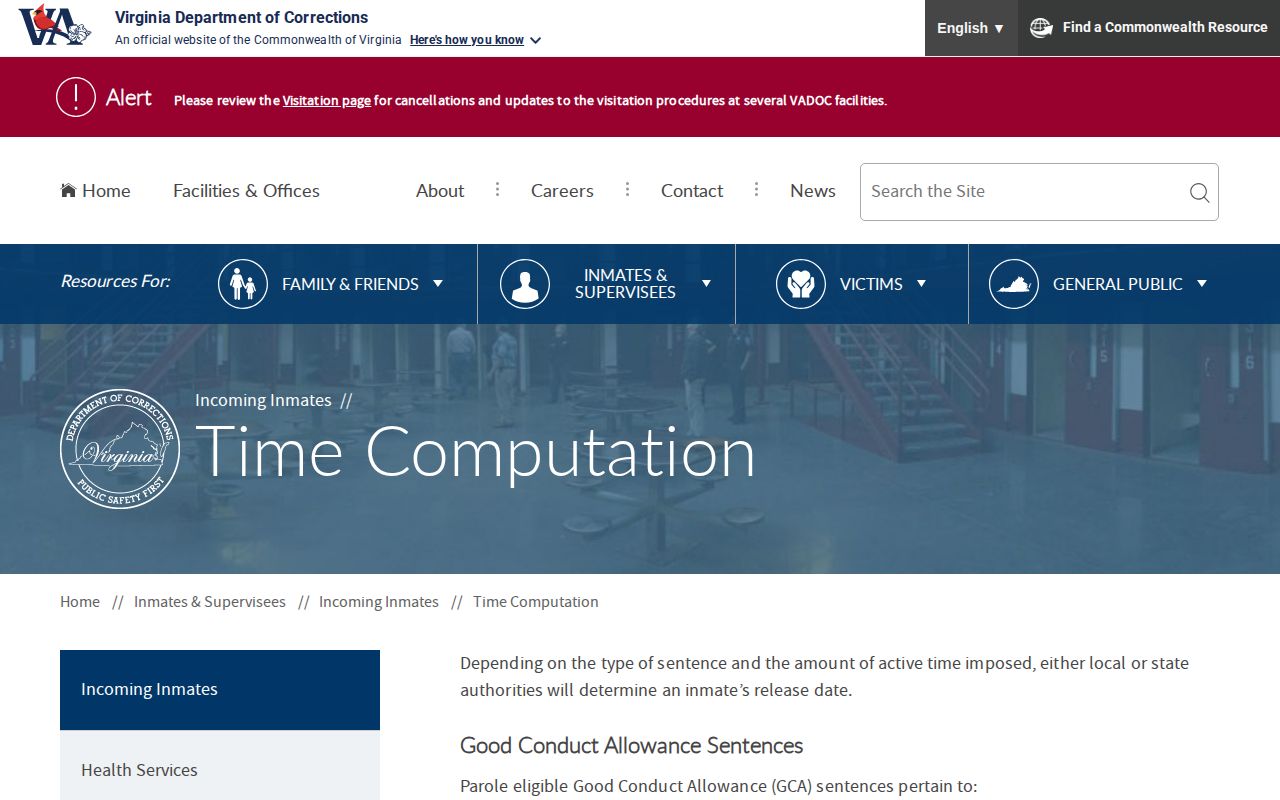
The published categories explain the framework, but only the custodian can apply the correct law, offense date, sentence structure, and credit class to one person.
Why Amelia Has No One Formula
The key local computation quirk is the split between a PRJ local sentence and a VADOC state-responsible sentence. VADOC's ESC categories cannot simply be applied to every misdemeanor or short regional-jail term. PRJ must read the Amelia commitment orders and use the local sentence rules that apply. A person can also be physically housed at PRJ under state authority, which makes the legal custodian more important than the building name.
A state calculation begins with the effective sentence and commencement date. It then incorporates qualifying presentence confinement credit, whether terms run together or one after another, and the lawful credit class. Disciplinary changes, forfeiture or restoration of credits, escape or other uncredited time, new sentences, revocations, detainers, and corrected court orders can alter the result. A detainer is a request or hold from another authority that may affect the next custody step. VADOC states that each record is unique.
The court record must also be read in sequence. Amelia General District Court can contain a misdemeanor sentence or the preliminary stage of a felony. Amelia Circuit Court can contain the felony adjudication, sentence, appeal, or revocation. A person may therefore have entries in both courts. Use the case numbers and final orders to decide which sentence is active, then give those orders to the agency computing time. A docket summary can explain the legal change, but it does not replace the custodian's calculation or prove the moment of exit.
Traditional discretionary parole was abolished for most felony offenses committed on or after January 1, 1995 under § 53.1-165.1, subject to exceptions. Older parole-eligible sentences rely on § 53.1-151. Geriatric conditional release under § 53.1-40.01 is a petition route for a qualifying person, not an automatic release date. This Amelia-specific channel split is why a public calculator cannot replace PRJ or VADOC.
Note: A VADOC credit category can explain a state date, but it should never be pasted onto an Amelia local sentence.
What Changes Amelia Release Dates
A projected date changes when a fact in the legal or custody record changes. Some factors can move a date earlier, while others move it later or replace it with a different custody event. A new order can correct the sentence. Earned credits can change with class and conduct. A detainer can cause release from PRJ or VADOC directly into another authority rather than the community.
| Factor | Possible effect | Record to check |
|---|---|---|
| Presentence jail credit | Credits qualifying time already held | Sentencing order and custodian computation |
| Concurrent or consecutive terms | Changes how multiple sentences combine | Final orders and time-computation summary |
| Credit class or discipline | Changes the rate, forfeits, or restores time credits | VADOC or PRJ authorized calculation |
| New sentence or revocation | Adds active time or changes the sentence structure | Later Amelia or other court order |
| Detainer or hold | Can lead to transfer instead of community release | Release entry and receiving-agency record |
| Parole action | Creates eligibility or a proposed release path, not guaranteed exit | Board outcome plus VADOC actual release |
| Court correction | Replaces an earlier calculation input | Amended or corrected final order |
Always keep the older check time when a date changes. It shows which agency value was available then and avoids presenting the first estimate as a clerical error without evidence.
Confirm the Amelia Release Event
A date lookup is complete only when the correct agency confirms the event. For a local Amelia case, call PRJ at (434) 392-1601 or request the existing booking-and-release entry. Ask for the release date and time, release authority or type, and receiving agency if transferred. Compare that response with the Amelia court order. For state custody, use VADOC's displayed status and release documents. A Board decision alone is not actual release.
Virginia Jail VINE can send a custody-change alert tied to a participating local record. VADOC's NAAVI system is separate and serves eligible victims of people under VADOC care. The Amelia County VINE inmate check explains that two-system split and the registration controls. A notification can lag operational processing, so preserve its source agency, event wording, and update time.
Federal custody calls for the BOP locator or federal docket, while an ICE transfer calls for the Online Detainee Locator and the named field office. A sound statement always identifies the system: released from PRJ, released from VADOC, transferred to another agency, or discharged from the named supervision term.