
Amelia Parole and Probation Compared
Parole, probation, and post-release supervision can all place a person in the community under legal terms, but they begin in different ways. The Virginia Parole Board decides discretionary parole and certain conditional-release matters. VADOC Community Corrections carries out field supervision through its Probation and Parole District Offices. A court imposes probation, often while suspending part of a jail or prison term. Post-release supervision may be a required part of a sentence after incarceration. The Amelia sentencing order is the best source for the type and length of supervision. A current VADOC record is better for the office now responsible.
The labels should not be blended. A parole grant lets an eligible prisoner serve part of a sentence outside prison under conditions. Probation is a court-ordered status and need not follow a prison release. Discharge means the identified custody or supervision term has ended. It should not be assumed merely because a name no longer appears in an active locator.
| Status | Who creates it | Best verification source |
|---|---|---|
| Parole | Virginia Parole Board decision for an eligible sentence | Board decision plus VADOC status and actual release record |
| Probation | Amelia General District or Circuit Court order | Sentencing order, docket, and VADOC supervising office |
| Post-release supervision | Sentence and applicable Virginia law | Final order and VADOC Community Corrections record |
| Discharge | Supervising or sentencing authority | VADOC or court record showing the term ended |
- Parole
- Conditional release from a parole-eligible prison sentence.
- Probation
- Court-ordered community supervision, often tied to suspended time.
- Absconder
- A supervisee alleged to have stopped reporting or left supervision without authority.
- Capias
- A court order directing that a person be taken into custody.
Check Amelia Post-Release Supervision
The public starting point is the VADOC Inmate & Supervisee Locator. Its name matters. The system includes people in VADOC prisons, people supervised by district offices, people in institutional hospitals, certain people held in local or regional jails under VADOC authority, and community corrections program participants. A district-office or community-supervision location supports the conclusion that the person is outside prison and supervised. It does not establish that every sentence or duty has been discharged.
Use a seven-digit DOC ID when known. The name route requires at least the first three letters of the first name and the full last name. Optional filters include location, race, gender, and age range. VADOC warns that its data is updated daily and may be inaccurate or out of date, so record the check time and copy the displayed office and status exactly.
- Identify whether the person came from PRJ, a VADOC institution, or another system. A PRJ release alone does not prove state supervision.
- Search the VADOC locator by DOC ID or the required name fields. Compare identifiers before selecting a same-name result.
- Read the location. A prison or jail points to custody; a Probation and Parole District Office points to community supervision.
- Search the Amelia court docket and final sentencing order for probation, suspended time, post-release supervision, or a later revocation.
- Confirm the precise district through the VADOC facilities and offices directory. Caseload transfers can change the office.
- For completed supervision that no longer appears, request the historical record from VADOC or the final order from the proper Amelia court.
The Amelia County released-inmate lookup provides the related PRJ, court, and transfer chain when the first issue is whether the person left confinement at all.
The official VADOC locator page shows the inputs and the agency warning that governs a live search.
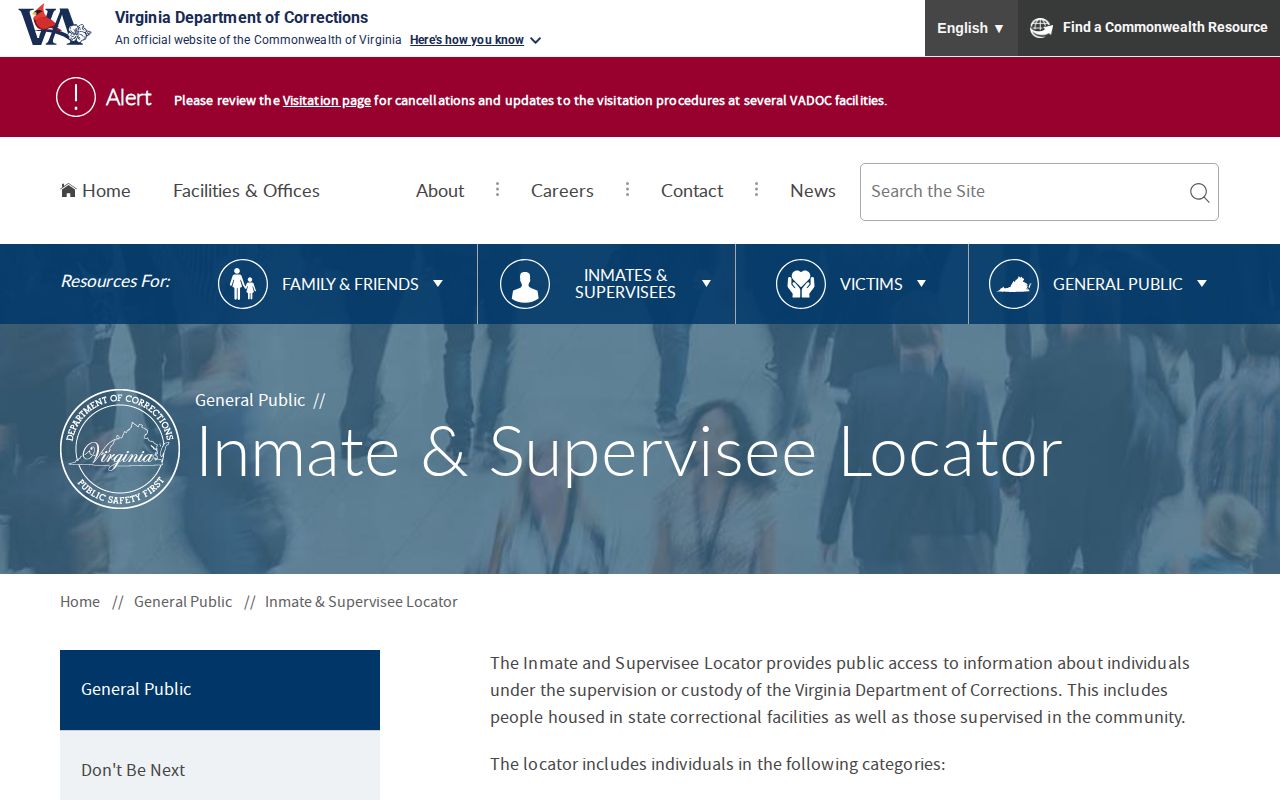
The search screen is a current custody-and-supervision tool. It is not promised as a permanent archive of every discharged Amelia County case.
Note: Preserve the locator's exact office label and daily-update date before contacting VADOC about an Amelia County supervision record.
Amelia Supervision Office Records
Amelia County is associated in the research cross-check with Petersburg District 7 when a person is actively supervised, but that geography is not enough to hard-code a current assignment. Specialized caseloads and transfers may place a supervisee elsewhere. Start with the live locator, then use the directory entry that matches the result. Give staff the public DOC number, full name, and the status being verified. Do not seek or publish a private reporting date, home visit plan, treatment detail, or case-plan information.
General record questions can also go through VADOC. The department's main contact and FOIA channels are useful when an active locator no longer shows a fully discharged person. A narrow request for public custody status history, the release or discharge date, and the supervising-office history is more useful than asking staff to create a new narrative.
VADOC Community Corrections
Confirm the current district in the official office directory.
P.O. Box 26963
Richmond, VA 23261
(804) 674-3000
VADOC maintains a separate FOIA contact for public records.
Virginia Parole Board
The Board handles parole decisions, not routine field reporting.
Amelia Parole Decision Records
Most Virginia felony offenses committed on or after January 1, 1995 do not carry ordinary discretionary parole eligibility. Virginia Code § 53.1-165.1 abolished that form of parole subject to stated exceptions. Older sentences and special categories require an individual review. Traditional eligibility under § 53.1-151 is only the point at which the Board may consider release. It is not a release order or date.
The Board's monthly decision reports are arranged by report and month, rather than guaranteed as a complete name-search database. Search the plausible month and adjacent months, preserve the document date, and copy the outcome wording. A grant, denial, deferral, reconsideration, or rescission describes the Board action. Actual departure remains a separate VADOC event. Conditions, detainers, and processing can intervene between the vote and release.
Public meeting notices and minutes appear on the Board meeting page. Meetings occur as scheduled, and the page is not a complete calendar of every institutional interview. Since July 1, 2024, the Board states that its final deliberation and vote occur in public meetings, while also warning that not every parole-eligible person will appear at a public meeting. The VADOC status and release record remain the final check.
Virginia Jail VINE and VADOC NAAVI can supply notices for eligible or registered recipients, but they follow different custody sources and rules. A parole-decision event is not the same as actual release. Preserve the alert's agency and time, then compare it with VADOC custody status. Federal supervised release is also a separate court-administered path and should not be labeled Virginia parole or probation.
Amelia Supervision Warrants and Violations
A supervision violation is an alleged breach of a court or VADOC condition. It does not by itself show the final outcome. The supervising officer may respond within authorized practice, while a court can issue a capias and later decide whether suspended time is revoked. The Amelia docket may show a show-cause or revocation event. Read later orders because an initial entry can change after a hearing.
An absconder status does not mean supervision ended. VADOC may list selected wanted supervisees, but absence from such a list proves neither compliance nor discharge. A warrant or capias should be confirmed through the issuing court or law-enforcement agency. Do not confront the person. If a current safety issue exists, use official emergency channels. For record verification, limit the inquiry to public status, issuing authority, and case entry.
Note: A later Amelia revocation order can change custody and sentence dates even after a period of community supervision.
Amelia Reentry Is Not Discharge
Piedmont Regional Jail names reentry services as part of its mission and separately describes Work Release and Home Electronic Monitoring. Those programs create an Amelia-specific trap for status checks. A participant may work, live, or move outside the secure perimeter while remaining legally assigned to PRJ or its program. Community movement is not the same as discharge from custody, probation, or a sentence.
Confirm the program's termination or release entry. The PRJ record should identify when local custody ended and whether another authority received the person. The Amelia sentencing order can show the legal basis and any supervision that follows. If VADOC later lists a district office, that record concerns state community supervision, not proof that an earlier PRJ program ended on the same date.
This distinction also helps with language. “Outside the jail” describes physical location. “Released from PRJ” identifies an end or change in PRJ custody. “Discharged” should be reserved for a source that says the relevant sentence or supervision is complete.
Confirm Amelia Supervision Discharge
Supervision ends through the authority that imposed or administers it. A probation order may expire or be ended by the court. Parole and state post-release supervision are documented through VADOC and, where relevant, the Board. The active locator is built for people currently in custody or under supervision, so it is not promised to retain every former supervisee. When the record vanishes, obtain a discharge or status-history record instead of treating the negative screen as proof.
Virginia court records and VADOC files answer different parts of the question. The final Amelia order gives the imposed term, suspended portion, and later revocation or discharge action. VADOC can identify its custody and supervision dates. Under the Virginia Freedom of Information Act, request existing public fields and ask for redaction of exempt details rather than a custom conclusion. Charges depend on actual work, and the agency may explain that part of an offender file is protected.
A precise conclusion names its scope: discharged from VADOC supervision, probation ended in the Amelia case, or released from PRJ while supervision continued. That wording avoids turning one completed duty into a claim that all legal obligations ended.